How to Reduce Floor Creaks Without Guesswork
5 November 2026
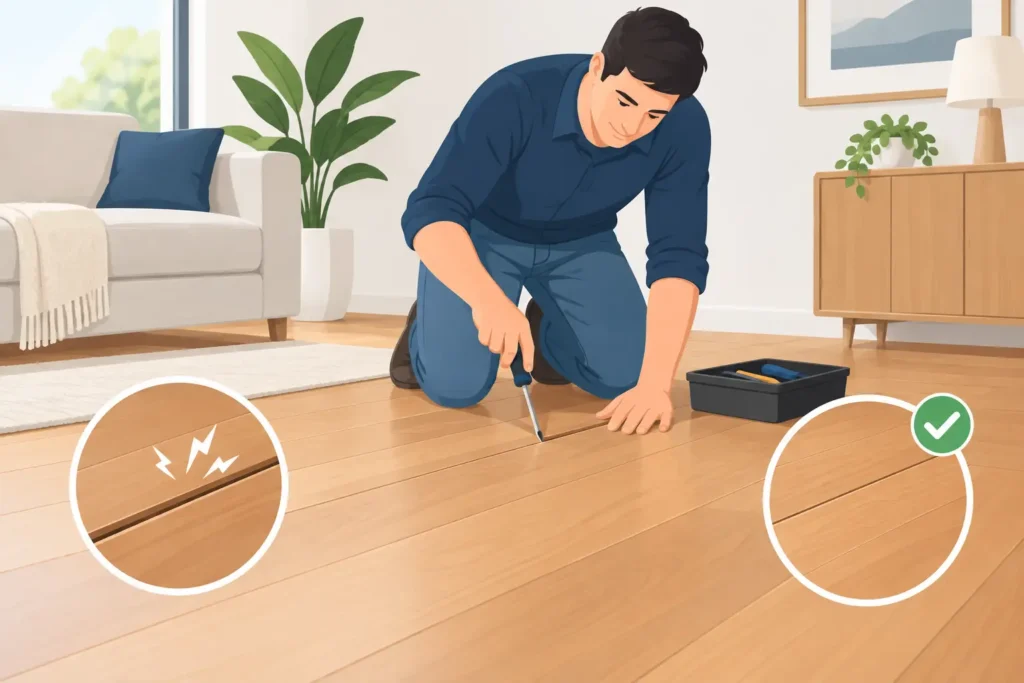
A creaking floor can make an otherwise well-finished room feel tired, particularly when the sound appears in the same spot every morning or whenever someone crosses the landing. Knowing how to reduce floor creaks starts with identifying what is moving. The floor surface is not always the cause: loose floorboards, joists, fixings, subfloor movement and changes in indoor humidity can all create that familiar squeak.
The good news is that many creaks can be improved without replacing an entire floor. The right solution depends on whether you have original timber boards, engineered wood, laminate, LVT or a carpeted floor with boards beneath it. Treating the symptom without finding the cause can make the problem return, so a careful first check is well worth the time.
Why floors creak in the first place
Most creaks are caused by two materials rubbing against each other as weight passes over the floor. In older properties, timber floorboards may have dried and shrunk slightly over the years, leaving small gaps around nails or against neighbouring boards. When a board flexes underfoot, the timber or fixing moves and makes a noise.
Floor joists can also be responsible. A board may no longer be held tightly to its joist, or the joist itself may move where it meets a supporting wall or noggin. In some homes, pipes or cables beneath the floor can rub against timber as the boards flex. This is one reason it pays to investigate rather than simply adding screws at random.
Modern floating floors can creak for different reasons. Engineered wood, laminate and some LVT systems need a flat, stable subfloor and a suitable expansion gap around the room perimeter. If the subfloor is uneven, the boards may flex at the joints. If the floor has been fitted too tightly against a wall, doorway or radiator pipe, seasonal movement may create pressure and noise.
Humidity plays a part too. Timber naturally expands when moisture levels rise and contracts in drier conditions, often making a creak more noticeable during winter heating periods. A small seasonal sound is not necessarily a sign of a failed floor, but a persistent or worsening creak deserves attention.
How to reduce floor creaks: find the exact source
Before attempting a repair, walk slowly across the area in soft-soled shoes and mark the noisy spot with low-tack masking tape. It helps to have a second person listen from below, if there is safe access to the ceiling underneath. One person can apply weight to the floor while the other checks whether the sound comes from the board, the joist, a pipe or a fitting.
Try pressing on either side of the noise, not just directly on it. If one particular board moves while those around it remain firm, the board or its fixings are likely to be the issue. If a larger area feels springy, the underlying joists or subfloor may need closer inspection.
For click-fit flooring, look for signs of restricted movement at the room edges. Remove a skirting cover or threshold only if you can do so without damaging the finish, then check whether the flooring is tightly trapped. A narrow expansion gap may be hidden by skirting or beading, but it still needs to be present.
Do not drill through a floor until you are confident of the joist direction and the position of pipes and electrical cables. Bathrooms, kitchens and areas close to radiators need particular caution. If there is any doubt, a qualified tradesperson is the sensible choice.
Fixing creaky timber floorboards
Where accessible timber boards are moving over a joist, re-fixing them is usually the most dependable repair. Existing nails can work loose over time. A properly positioned screw gives a firmer hold and is less likely to lift again, provided it enters the centre of the joist and is the correct length.
Pre-drill the board to reduce the risk of splitting, then use countersunk screws so the heads sit below the surface. If the boards are to remain visible, fill the screw holes with a suitable timber filler matched as closely as possible to the floor colour. For a painted floor, the repair can be filled and redecorated once it is secure.
A narrow gap between boards can sometimes cause rubbing. Where boards are exposed and the gap is consistent, specialist timber slivers or a flexible filler may help, although this should not be used to force a moving board into place. Rigid filler can crack if the timber continues to move with the seasons.
If the creak is below carpet, lifting the carpet and underlay may reveal the board joints and fixings. This can make a repair straightforward, but take care with gripper rods around the room perimeter. If the carpet is in good condition and you are unsure about lifting and re-stretching it, it is often better to have the work carried out professionally.
Avoid relying on oils, sprays or powders as a long-term cure for timber boards. They may temporarily quieten friction, but they do not secure loose timber and can leave residue that affects finishes or future work. The most effective repair is normally to stop the movement itself.
Creaks in engineered wood, laminate and LVT
With a floating floor, adding screws through the visible surface is rarely the answer. It can damage the flooring, invalidate a product warranty and prevent the natural movement the floor was designed to allow. Instead, look at the preparation beneath it and the clearance around it.
Engineered wood and laminate should sit on a clean, level, dry subfloor with the correct underlay for the product and room. A hollow or squeaky area may indicate a local dip in the subfloor, a damaged board joint or insufficient support beneath the floor. In some cases, a small section needs to be carefully lifted so the underlying issue can be levelled or repaired.
LVT is generally quieter underfoot than wood-based floating products, particularly when fully bonded, so a new creak beneath LVT often points to the subfloor rather than the LVT itself. Loose plywood, uneven screed or movement in old floorboards below can all transfer noise through the finished surface.
Do not assume thicker underlay will solve every noise problem. The wrong underlay can allow too much movement under a click system, making joints work harder rather than reducing sound. Always match the underlay to the flooring type, subfloor and any underfloor heating requirements.
When a creak needs professional attention
A single squeak in an older home is usually an annoyance, not an emergency. However, seek advice if the floor feels noticeably soft, dips under weight, has recently become much noisier, or is accompanied by cracking in nearby plaster. These signs can indicate a more significant issue with a joist, subfloor or moisture damage.
It is also wise to call in help where access is limited, the floor sits above a bathroom or kitchen, or the room contains underfloor heating. The cost of a careful inspection is modest compared with repairing a punctured pipe, damaged heating cable or premium finished floor.
For a larger renovation, dealing with squeaks before new flooring is installed is one of the best investments you can make. Once a quality engineered wood floor, laminate or LVT has been laid, the subfloor is far harder to reach without lifting part of the installation.
Build a quieter floor from the start
If you are choosing new flooring, preparation matters as much as the visible finish. A stable, dry and level base gives engineered wood, laminate and LVT the best chance of performing quietly and looking good for years. It is worth discussing the age of the property, the existing floor construction and how the room is used before selecting a product.
At Oakley Wood Timber, homeowners can compare a huge selection of premium wood flooring, laminate and LVT in person, with helpful staff on hand to talk through suitable options for the room and subfloor. Seeing the boards, finishes and fitted examples can make it easier to choose a floor that suits both the home and the budget.
A quiet floor is usually the result of careful diagnosis rather than a quick fix. Take time to locate the movement, repair it safely, and give any new floor the stable foundation it deserves.